Showing posts with label Math. Show all posts

Tuesday, January 15, 2013

Review: Make It Real Learning

We all remember those story problems about two trains traveling certain speeds at a given distance in opposite directions or asking the percentage of blue-eyed boys in a given classroom, as if this would be must-know information later in life. Problems like these didn’t exactly make you jump up and down with enthusiasm to learn the math concepts, did they? The relevance of learning how to solve such problems is lost on most students and instead leaves them asking, “When am I ever going to use this?”

Students want to know *why* they are learning certain material and how it might be relevant to them either in the present or near future. When my son first started learning fractions, I usually used two units in my explanations to bring it home better: snack food and money. However, as important as cookies and dollars are for a ten-year-old boy, they can only take you so far. Now that he’s headed toward high school, he really needs to see how what he’s learning today applies to his future. I often wish the story problems in the textbooks did a better job making the story problems relevant - that they would make them real.

Make It Real Learning (MIRL) has tackled the “Why do we need to know this?” chant from math students and developed a workbook series of activities showing how math is needed in our every day lives.

library_2

I was sent the digital format of Activity Library Volume II, targeted to grade level 3 through college, to review. There are eleven workbooks in Volume II with the following topics/titles:
  • Arithmetic II
  • Fractions, Percents, Decimals III
  • Fractions, Percents, Decimals IV
  • Geometry I
  • Geometry II
  • Graphing & Other Algebra Skills I
  • Graphing & Other Algebra Skills II
  • Linear Functions III
  • Periodic & Piecewise II
  • Quadratic II
  • Sets, Probability, Statistics II
Each workbook includes ten activities, which are mapped to the Common Core State Standards for Mathematics. Each activity is about two pages long and comprised of multiple questions based on a real-life scenario. The activities are ideal for 1-2 class periods of a traditional classroom.  They can be done in groups or completed by as single student and are well suited for homeschooled students.

All of the activity topics are high interest and should appeal to a broad range of students.  The topics range from candy purchases to college tuition and beyond.  Students will learn how math relates to music downloads, interest and savings, construction planning, travel expenses, sports, cooking, healthcare costs, gas prices, take home pay and even current events and concerns such as elections and autism awareness.

The scenarios presented in the activities are drawn from real situations, real data, and even include links to actual websites and studies.  For example, an activity about purchasing candy and calculating shipping costs from an online website includes a link to the website, the actual costs of the candy, and a copy of the shipping fee table.

Make It Real Learning’s Activity Volume II does not contain actual lessons, detailed explanations, nor is it a complete curriculum. However, each activity is immediately followed by an answer key showing the steps in the solution, making it easy for the supervising parent or teacher. I appreciated not having to open a different file for the solutions and having the solutions readily available.

To get a feel for the format and structure of the activities, there are 20 free sample real-world math activities available from Volume I and II.

While there are some activities suitable for late elementary, I felt the majority of the activities were better suited for late middle school through high school grade levels. With an 8th grader and a 10th grader in my household, the level of the activities is about perfect for our family to use now and have plenty of material available for later.

I always try to make math real for our kids as we live life, while we do home projects, bake and shop, or pay bills. However, I can’t always seamlessly align our experiences with what my kids happen to be learning in their math curriculum. With these activities targeting specific concepts, I think we’ll get plenty of use of this quick resource the next time my kids sigh and whine, “Why do I need to know this?” I’m looking forward to continuing to use this resource.

Activity Library Volume II is available at the Make It Real Learning’s website as a digital download for $39.99 or as a Volume I and II bundle at a discounted price of $69.99 for the pair. If you prefer a hard copy, a print version is available at Lulu for $54.99.


As a special to my readers, receive 40% off by clicking the link below!


I received a free copy of product from Make It Real Learning in exchange for an honest review. I was not required to write a positive review nor was I compensated in any other way. The opinions I have expressed are my own. This review contains affiliate links. I am disclosing this in accordance with the FTC Regulations.

Friday, April 27, 2012

Review: Balance Math (Critical Thinking Co)

In case you are short on time today, let me give you the short version of this review.  I LOVE products by Critical Thinking Co. They are very nicely done, easy to use, and just fabulous. Head on over to their website and check out the vast amounts of resources for your homeschool.  Right now.  Go on.  Try not to buy one of everything! (Psst!  They have bundles if you’d like to try!)

Now, for those of you who require more detail and specifics, I was sent two products for review, both covering math topics targeting grades 4-12. 
 
Balance Math Teaches Algebra by Robert Femiano presents algebra with a visual approach using balance scales. There is a 2-page sample at the website to print and try out a few of the 52 activities provided. The activities are presented from simple to complex, building upon the previous pages.

PhotobucketMy son,who is currently in pre-algebra, has a pretty mathematical mind. However, during his math work, I noticed that he doesn’t always get balancing equations. He understands how to do the calculations, how to combine like terms, and use other skills needed to balance equations. However, he doesn’t always recognize that the equals sign in an equation means if you did something on one side of the equation, you must do the same on the other to maintain balance. This isn’t too surprising, since he is still working through some directional challenges related to his struggles with dyslexia. It is frustrating, however, and we've been working on recognition of the equals sign as creating two sides of the equation.

When I gave my son his first sheet of Balance Math to complete, he immediately knew how to work the problems. In fact, he was working the problems in his head faster than I was. Usually when new material is presented to him, he needs to go through examples and do a few problems. Balance Math was completely intuitive for my visual learner. It instantly clicked.

Balance Math &More Level 2 by Robert Femiano, includes some of the same activities as Balance Math along with two additional activities called Tic Tac Math and Inside-Out Math.  There is a 3-page sample at the website that will provide examples of the differing puzzles offered in the 38 activities.  There are three levels of this series, with Level 2 focusing on multiplication and division of whole numbers, with a few problems using fractions.

We focused on just the Tic Tac Math and the Inside-Out Math since we were already doing the Balance Math sets from the other book.  One thing I noticed with these types of problems was it wasn’t the math my son struggled with, but the sequencing and accuracy needed. My son is too quick to get frustrated with multi-step problems where the answer to one part is needed for another.  Part of this is because he is very much a big picture person and breaking things down into parts presents more of a challenge.  When adding that to a tendency to rush work and make silly errors, the outcome is one frustrated boy.  I noticed that both of these exercises forced him to practice both his sequencing and accuracy skills in a rather non-threatening and visual manner.  While he didn't enjoy the other activities in this book as much as the Balance Math, I appreciated that they provided some much needed practice in some weak areas.  I always mourn an incorrect answer because of silly calculation errors!

Both of these titles are reproducible for home or classroom use, which makes them a great value as the copyright legally allows use for multiple children. The pages are perforated to make copying convenient.

As expected, these are two titles that I can definitely recommend to those looking for some supplemental math materials. Balance Math Teaches Algebra is available for $14.99 and Balance Math and More Level 2 is available for $9.99. Explore many of the other products available from Critical Thinking Co. with the printable samples and software demos available. 

Disclaimer: This review was provided as a result of my participation in The Old Schoolhouse Magazine Crew. I was provided the product free of charge in exchange for my honest review. I have received no other compensation. I strive to give a balanced overview of each product, detailing my opinion of both pros and cons and how the product worked for my family. What works for one family may not work for another. I encourage you to read reviews of other Crew members and research sufficiently to determine if any product will be a benefit to your homeschool. You may read more reviews on this product by visiting here.

Monday, April 23, 2012

Review: Prufrock Press


When I am exploring something new, I tend to be a researcher. I check out a stack of books, scour the interest, and talk to those with knowledge in the area.  It was no different when I started homeschooling and I discovered there is no shortage to materials on homeschooling, whether about the reasons, the methods, or a source of encouragement.  What I did find, however, is that there is a shortage of information on homeschooling gifted children.  Aside from a few titles scattered here and there, gifted education materials are often geared toward traditional teachers.  During my hunt for information, I discovered Prufrock Press, a leading publisher for gifted education resources. In addition to materials that can be applicable to any homeschool or classroom, Prufrock Press now has some homeschooling-specific resources as well.

I received a sampling of titles that may be of interest to homeschoolers for review, which included Homeschooling Gifted and Advanced Learners by Cindy West, Free Resources for Elementary Teachers by Colleen Kessler, Math Dictionary for Kids By Theresa Fitzgerald, and an issue of Creative Kids Magazine.

When my stack of books arrived, the first title I picked up was Homeschooling Gifted and Advanced Learners ($24.95). This is a brand new, and much needed, release for homeschoolers of gifted children.  Written by a 14-year veteran of homeschooling, this title covers many of the same topics that any other homeschooling title would, such as the benefits of homeschooling, choosing curriculum, record keeping, and college.  However, these topics are covered specifically with the gifted student in mind, which often changes the needed information and suggestions.  In addition, topics specific to gifted kids, such as early college considerations, are covered.  “Real-life examples” are included throughout for a more personal feel.  When I reached the author’s bio at the end of the book, I realized that I had “seen her around” online homeschooling circles and read her blog, http://ourjourneywestward.com  in the past, which added to the personal feel of sitting down with a fellow homeschoolers for some needed advice.

Don’t let the title Free Resources for Elementary Teachers ($12.95) fool you.  Homeschoolers will love this book!  Furthermore, I discovered that the author, Colleen Kessler, is a former school teacher turned homeschooler! Utilizing Internet resources, chapters are broken down by subject.  The name, URL, and a brief description is given for each resource listed. Chapter 10 even includes a list of homeschool bloggers who share great ideas and downloadable resources for the home or classroom. This looks to be a very handy reference tool for teachers and parents and is currently 20% off with the code FRES20.

Math Dictionary for Kids ($12.95) by Theresa Fitzgerald, is a guide that helps students quickly find definitions, illustrations and examples to help them solve math problems.  Intended for kids grades 4-9, this title includes terms and strategies in algebra, geometry, statistics, fractions and measurement.  This is a great tool to have on the shelf for reference during math work.


Do you have a creative writer in your home? Creative Kids Magazine, $19.95 for a 1-year subscription, is for kids, by kids.  Kids age 8-16 have the opportunity to have their artwork, stories, poems, and games published in this magazine written entirely by kids.  My daughter has been a subscriber of this magazine for a couple of years and has really enjoyed reading the work of other creative kids.

Head over to Prufrock press and check out their selection of resources for gifted education. In addition to educational resources, Prufrock has a whole selection of Parenting Resources to assist parents in meeting the needs of their gifted children.

Sunday, April 15, 2012

Review: Looking at Lines (AIMS Education Foundation)

Photobucket

Until this past fall when I was assigned a review of AIMS Earth Book, I had never heard of AIMS. AIMS, which stands for Activities Integrating Mathematics and Science, is a non-profit organization.  It has been publishing hands-on instructional materials that build conceptual understanding in mathematics and science since its beginning in 1981 with a grant from the National Science Foundation.

You'd think after being around for 30+ years and providing materials specifically geared toward hands-on learning, that AIMS would have been more familiar to this veteran homeschooling mom of a kinesthetic learner. However, while they do have one product that specifically mentions homeschoolers as the target audience, AIMS has been more popular among traditional teachers and underutilized among homeschoolers.  A friend of mine recent wrote an article about The Great Divide among resources targeted toward either traditional schools or homeschools. In the article she writes:
Another surprise that I observed is that non-homeschoolers tend to know and use resources marketed to schools, while homeschoolers tend to know and use resources marketed to homeschoolers, and often, neither side knows what little gems the other has to offer.
AIMS is definitely one of those "little gems" that homeschoolers should be exploring.

This time, I received the print version of Looking at Lines for review. Looking at Lines, covering algebraic concepts, is geared toward grades 6-9.

Introduce algebraic concepts in their natural setting with activities drawn from real-world phenomena. Covers three sub-groups of linear functions: proportional relationships, non-proportional relationships with positive slopes, and non-proportional relationships with negative slopes.
Thirty-two activities are provided within three sub-groups and 232 pages. All of the student pages in the book are also provided on a CD in PDF form for easy printing. A 31-page sample, including a complete Table of Contents, is available for viewing.


Photobucket

While users can pick and choose activities and the order of exposure, it is recommended that students start with those activities in Part One in order to build a foundation. My son is currently in Pre-Algebra and the earlier activities seemed best suited to his current level.  Interestingly enough, the very first activity was about Celsius and Fahrenheit conversions, which happens to be the very concept that is being covered in his current math program. The activity guides students through the process of determining the proper equation to figuring out one measurement when given another by having students graph and analyze temperatures using a standard thermometer. Similar activities in Part One involve analyzing measurements and conversions of jumbo versus standard paperclips and inches versus centimeters.  Of course, students can simply be given conversion factors for their math work, but these activities help them understand them by doing, given them a better foundation.

Having now reviewed both science and math activity books for AIMS, I've found the math activity book is much easier to adapt classroom activities to one for a single student.  The materials are not as involved, and the activities can easily be done by one student with a teacher to guide.  Each activity gives very detailed information for the teacher on the goals of the activity and how to best provide direction for the student. I am now taking a much closer look at the AIMS math resources and Activity Books for supplemental math resources.

Looking at Lines is available for $24.95 in either a PDF version or print version with CD at the AIMS website.

Disclaimer: This review was provided as a result of my participation in The Old Schoolhouse Magazine Crew. I was provided the product free of charge in exchange for my honest review. I have received no other compensation. I strive to give a balanced overview of each product, detailing my opinion of both pros and cons and how the product worked for my family. What works for one family may not work for another. I encourage you to read reviews of other Crew members and research sufficiently to determine if any product will be a benefit to your homeschool. You may read more reviews on this product by visiting here.

Saturday, December 3, 2011

Review: Medieval Machines Pack (Pitsco)


Two of my son’s favorite words are “build” and “projectile”. As you can imagine, he was super excited when the Medieval Machines Pack from Pitsco arrived for review.

Our pack included:

  • Trebuchet Kit
  • Catapult Kit
  • Mass Plates
  • Siege Machines Book

In addition to the above Medieval Machines Pack, we also received:
The first machine we built, by the request of my son, was the trebuchet.  Punching out the pre-laser cut pieces from the wood was no problem; in fact, some of the pieces had already come loose during shipping. 
1
I was a little concerned that the wood pieces would not be very sturdy, but this was an unfounded worry.  While lightweight, the wood strength was up to the task at hand.

The instructions were very clear and my son was able to put the trebuchet together almost completely on his own.  The requirements to 2read and follow directions during the building process, measure (twice) and cut (once), and be precise were great learning exercises.  The most difficult part of putting the trebuchet was the sling portion, which involved a piece of nylon and thread that needed to be attached both to the nylon and the machine, with the end result of thread of equal lengths on either side of the sling.  A bit tricky, but not difficult with some patience.  Patience, however, is not something that comes easily to my son, which is also the reason we opted to use Super Glue to construct our machine rather than wood or Tacky glue that might take a bit longer to dry.

5
We built the kits on two different days, but doing both in the same day is completely feasible. While the trebuchet took us a bit longer, construction of the catapult was less than an hour. My husband joined in on the catapult construction. (As a side note, these kits are great for getting Dad involved with homeschooling!)  Again, the construction for the catapult was simple, aside from a very tight-fitting dowel.  Wood glue was used for the construction this time, and I found that to work better.  On the trebuchet, I ended up regluing a couple of pieces together.

Both kits have survived a fair amount of play battles.   My son set up a battle field of pewter figurines, and needed to adjust either the size of his projectile, the distance of the machine from the target, or the load used in order to hit his target. While the included Siege Machines book has experiments and activities to do with the kits, free play alone has provided a natural learning experience.
4The Siege Machines book includes a history section among its 32 pages, in addition to the science behind them, hands-on experiments, and math integration. The last few pages are devoted to the standards addressed from three national education organizations, such as NSTA, ITEA, and NCTM. As a testament to the focus of learning through play of this product, we discovered this same kit is also distributed in the Lego Education catalog. As a Lego fan, that made my son love the kit even more!

Overall, I found this kit to be an exceptional value of building, learning, and playing and a wonderful blend of educational and just pure fun.

The Medieval Machines Pack can be purchased from Pitsco for $21.95. Be sure to check out the many other STEM (Science, Technology, Engineering, and Math) related items available or request a catalog.

 See what others have to say about this product by visiting the official TOS Crew blog!

 Disclaimer: This review was provided as a result of my participation in The Old Schoolhouse Magazine Crew. I was provided the product free of charge in exchange for my honest review. I have received no other compensation. I strive to give a balanced overview of each product, detailing my opinion of both pros and cons and how the product worked for my family. What works for one family may not work for another. I encourage you to read reviews of other Crew members and research sufficiently to determine if any product will be a benefit to your homeschool.

Saturday, January 29, 2011

Review: TenMarks


Founded by entrepreneurial parents searching for a better way to help students achieve their potential in math,TenMarks is an online subscription service covering math content for grades 3-10.

TenMarks approaches math learning with three simple principles:
  1. Personalized Learning Makes All the Difference.
  2. On-Demand Instruction Provides Help When You Need it.
  3. Practice Builds Confidence and Improves Achievement.
When signing up for the program, both the parent and the student receive separate login information.  Each week, the student is assigned a certain number of worksheets to complete.  The default is 4 weekly worksheets, but a parent can adjust the assigned number in the range of 3-7  The worksheets are done completely online (e.g. they are not printed out) with multiple choice answers.  From their account parents can view report cards, customize curriculum, and set up rewards for each student.

While this might all sound a bit ho-hum, TenMarks has a list of features that makes this program more appealing than it initially sounds.

The information is organized, both visually and for teaching concepts.  Each grade has a list of albums to complete.  One album, consisting of tracks, covers an entire concept.  Each track covers one single concept, with worksheets assigned for each track.  Furthermore, parents have the option of removing or rearranging albums.

While the material sequence is very organized, it is also visually organized for the user. When a student signs on, the progress they've made is very clear.  The page shows the album they've just completed, the current worksheets, and what is ahead.  Also, there is a visual display with outline figures that are colored by the percent of work completed.


Students have the option to practice concepts and are also assigned tests.  In the practice section, students can select worksheets from any album from any grade. Whether they need some review, or would like a challenge, the practice section is the place to go.  Also, timed tests are available for every album.  If a student does not score well, the tests can be taken again.

One of the best features of this program is the hints and videos available for each question.  I know that often times my children will call me over for help with their regular math work and all they really need is a little hint.  TenMarks has 3 hints available for each question and 1 video.  The program keeps track of hints and videos used.  Overuse will reduce the level of concept strength, which is also tracked for each concept.  Worksheets that have low concept strength are reassigned to the student.

It isn't just all work and no play either.  Students can earn unlock games as they complete worksheets.  Parents can also set personalized goals for motivation. 

Now, there are a few issues I did have with the program.  One of the greatest irritations was that sometimes the videos did not match up to the question.  For example, my son was working on a problem that required him to determine if a number was divisible by 4.  Not knowing how to approach the problem, he clicked the video.  While the video did talk about determining divisibility by other numbers, it did not show the student divisibility by 4. He was still stuck. Also, one of the videos used symbols for division that weren't the norm.  It had potential to be very confusing for some.  While I loved that the videos were available, they sometimes were not as helpful as they could be.

Another issue is that there were no limits on the games once they were unlocked.  Unlocking the games was very motivating, but the games themselves were very tempting.  My kids were great about not playing the games until after they finished a certain number of worksheets, but the problem cane with losing track of time.  Many of the games weren't related to any math concepts and were mindless (though apparently fun!).

Lastly, while the multiple choice had appeal for my pencil-phobic son, I also had to keep an eye on how he was approaching his answers.  Sometimes he would just make a guess, and he's very good at intuitively coming up with the correct answer without even really knowing how to work a problem.  As with any online program, a parent still needs to keep tabs on the student to make sure they are using the program as fully intended.

Overall, I really felt that TenMarks achieved the three simple principles upon which the program is based.  The learning is personalized, help is available on demand, and the program offers (and forces through reassignment of concepts) plenty of practice.  I felt the visual layout of progress was very encouraging to the student and I liked the control features given to the parent to customize the curriculum.  The minor irritations experienced did not outweigh the variety of positive features offered.

Strangely enough, though they have done numerous online math programs, both of my kids didn’t mind doing the worksheets on TenMarks.  In fact, my daughter would often do TenMarks before her other work, rather than putting it off as she typically does with math work.  The structure of TenMarks, in combination to the progress tracking and reward systems, seemed to appeal to my two indifferent math students. With math not making the top of the list as a favorite subject, it wasn't something that brought on lots of excitement. However, TenMarks was a program they willingly used without much complaint.  In our house, that is quite significant.

While I would not use TenMarks as a stand-alone program, it is definitely one to consider for supplement and practice. TenMarks is available at a very reasonable $10 a month, $49 for 6 months or $89 for 12 months. You can try the entire system by signing up for a free trial.  Visit the TenMarks website to subscribe or learn more.

Read what other reviewers had to say about TenMarks by visiting the official TOS Homeschool Crew blog.

Disclaimer: This review was provided as a result in my participation in The Old Schoolhouse Magazine Crew. I was provided the product free of charge in exchange for my honest review. I have received no other compensation.

I strive to give a balanced overview of each product, detailing my opinion of both pros and cons and how the product worked for my family. What works for one family may not work for another. I encourage you to read reviews of other Crew members and research sufficiently to determine if any product will be a benefit to your homeschool.

Wednesday, January 12, 2011

Review: Virtual Nerd

If you've ever hired a tutor, you know how costly they can be.  Tutors in our area run anywhere from $25-50, depending on the subject and expertise of the tutor.  As much as it hurts the budget, sometimes a little extra help is necessary in getting over an academic hump.  The one-on-one attention, with the ability to stop and ask questions during an explanation, is needed when a student is having difficulty with a concept.  Sometimes searching the internet and sites like YouTube for tutorials just doesn't cut it, you know? But private tutoring isn't affordable at all to some, and certainly not regularly for most.  It would be nice if there were something in between private tutors and random internet searches when academic roadblocks are met.


Meet Virtual Nerd, an online service that offers video tutorials in math and science, including Pre-Algebra, Algebra 1, Algebra 2, and Physics.  When I first heard about Virtual Nerd, I was a little underwhelmed at the concept.  I mean, there are plenty of online math and science tutorials available with a few clicks and a good search engine.  In addition, there seems to be an overabundance of math help websites, for a fee or free.  What makes this one any different?

First of all, let's cover the information presented. Content of these subjects isn't skimpy.  For example, there are 450 algebra tutorials that cover a total of 18 hours.  In addition, the site has plans for adding more subjects and new features in the very near future. One feature I thought unique as far as content is the textbook search topics.  The textbook search gives a student the option of finding tutorials and example problems that correlate to a particular text.  Right now this feature only covers Algebra texts from Prentice Hall, Holt, Glencoe, and McDougal Littell.  However, if you are working from one of the available texts, it is a pretty neat feature.

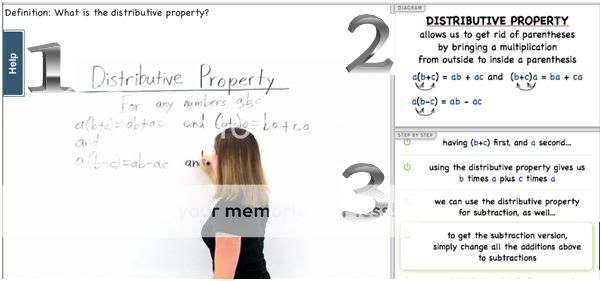
Probably the most useful feature of Virtual Nerd is the Dynamic Whiteboard.  As the video tutorial is playing, a student can view all of the steps on a small whiteboard just to the right of the video.  Within the whiteboard, students can advance the video to specific steps or find in-context links to pre-requisite videos on that concept. Also, once the video tutorial is completed, related tutorials are recommended.
Area #1 is the video presentation. Area #2 presents the problem as a digital whiteboard format.  Area #3 gives the student the ability to interact by jumping to individual steps, read definitions of terms, or get links on related content.
In addition to the above, the instruction in each tutorial is clear. I appreciate that the tutorial presenters are young, enthusiastic, and include both males and females.  The website is also very easy to navigate and has a  pleasing and professional look, without a lot of unnecessary information.

I was able to use Virtual Nerd with both my 6th grader and my 8th grader.  My 6th grader was able to use it for some of the pre-algebra concepts found in your typical early middle school curriculum.  My 8th grader, currently in Algebra, was able to find plenty of tutorials for whatever concept she was studying. Neither had any trouble with the explanations, nor navigating the site. Often times I would just add to their daily schedule a search word or phrase that covered a topic they needed some refreshing or explanation on, and have them go independently from there.  I would have loved to see some chemistry tutorials, and soon found that was planned for the near future (August 11), along with other math and science subjects.

Overall, I think Virtual Nerd is a well-done website that provides a more affordable alternative to a private tutor and is more focused than some of the other sites out there.  I felt the regular monthly fee was a bit steep for casual use, but the value increases considerably if one is able to make use of more than one subject and/or uses it as a regular tool for homeschool learning. Other memberships are available if the monthly fee is out of your budget.

A free 2-hour trial is available if you would like to try before you buy, always something I recommend when available. Other options include a $5 day pass, $19 weekly pass, $49 monthly fee, or a $129 3-month subscription.  This appears to be an evolving website with many changes and additional services in store, including new subjects and features, such as quizzes. It is definitely a site to keep an eye on. Visit the Virtual Nerd website for more information or to sign up for a membership.

To read what others had to say about Virtual Nerd, please visit the official TOS Crew blog.

Disclaimer: This review was provided as a result in my participation in The Old Schoolhouse Magazine Crew. I was provided the product free of charge in exchange for my honest review. I have received no other compensation.

I strive to give a balanced overview of each product, detailing my opinion of both pros and cons and how the product worked for my family. What works for one family may not work for another. I encourage you to read reviews of other Crew members and research sufficiently to determine if any product will be a benefit to your homeschool.

Wednesday, September 8, 2010

Review: Math Tutor DVD Pre-Algebra and TI-84 Tutor


Math Tutor DVD has become a familiar product since my first exposure to it two years ago. Since then, I have recommended it to both homeschoolers and traditional schoolers wanting to provide extra math instruction to their students.  I've previously reviewed the Basic Math Word Problems,  Algebra 2, and Young Minds Numbers and Counting titles. You can read complete reviews on these products here and here. I've also purchased additional titles to add to our homeschooling math resources.

This time, I happily received two more titles to add to our collection: Pre-Algebra Tutor Volume 1 and The Texas Instruments TI-83 / TI-84 Calculator Tutor.

Before I go into the specifics of these titles, let me first give a brief overview of Math Tutor DVD.  More background information is also included in my previous two reviews.  Math Tutor DVD is a provider of DVD and online math tutorials.  The levels covered are primarily Algebra through Calculus (and beyond!), but even some preschool and elementary level titles are available. The instructor, Jason Gibson, who has a BS and two Masters in Engineering and Physics, previously worked at NASA before focusing on his DVD offerings.

While his credentials are certainly impressive (we are talking a rocket scientist, folks!), Gibson is quite humble and believes that you don't need to be a genius to truly understand math and other subjects that tend to intimidate students, and perhaps parents too.
Folks like Beethoven who could compose music while deaf, or Einstein who made incredible leaps of insight in physics - are the true geniuses.  Everyone else, like you and me, just need to be introduced to the right instructor early on to break the process down and make the topics understandable.  With understanding comes confidence, and confidence is 100% the name of the game in math and science.
Gibson has a true knack for taking the complex and breaking it down into understandable steps.  Not only is he a rocket scientist, he has true talent in teaching as well.

Now, on to the products that I received.  First up is The Pre-Algebra Tutor Volume 1. This 5-hour DVD teaches the fundamentals of Pre-Algebra.


Photobucket

Topics included are:

Disk 1
  • Real Numbers
  • The Number Line
  • Greater Than, Less Than, Equal To
  • Absolute Value and Adding Integers
  • Subtracting Integers

Disk 2
  • Multiplying Integers
  • Dividing Integers
  • Powers and Exponents
  • Order of Operations
As I stated earlier, the explanations are very detailed and concise for all topics. Click below to view a sample lesson.


The Texas Instruments TI-83 / TI-84 Calculator Tutor is a new product for Math Tutor DVD.While our current algebra curriculum does not require use of this calculator, this is *the* graphing calculator to have and one that is in our near future of must-have tools.  Gone are the days of simple calculators (Does anyone else remember when 4-function calculators hit the general public market at around $100?).  Many schools are telling parents that they not only need to purchase this calculator for their students, but the student must be proficient at using it before the start of class.

Rather than being stuck with a boring instructional manual, this 8-hour DVD covers all the major functions of the calculator in a step-by-step manor through working out problems. 

Photobucket

Topics covered are:

Disk 1
  • Overview of the Calculator 
  • The Mode Menu
  • Basic Arithmetic and Exponents
  • Logarithms and Square Roots
  • Sin, Cos, Tan
  • Scientific Notation and Storing Variables
  • The Math Menu and Catalog Menu
  • Convert between Fractions and Decimals
  • Finding the Min and Max of a Function
  • Calculating Derivatives and Integrals
  • Absolute Value, Rounding, and Integers
  • Converting between Degrees and Radians 
  • Working with Complex Numbers
Disk 2
  • Using the Equation Solver 
  • Graphing and Tracing Functions
  • Using Tables and Split Screen Modes
  • Find the Exact Value of a Function Using Graphing
  • Finding the Zeros of a Function using Graphing 
  • Finding the Max and Min of a Function using Graphing 
  • Finding Intersections of Functions using Graphing
  • Finding the Derivative of a Function by Graphing
  • Calculating the Definite Integral by Graphing
  • Drawing on a Graph 
  • Graphing and Tracing Sequences
Disk 3
  • Graphing and Tracing Parametric Equations 
  • Converting between Rectangular and Polar Coordinates
  • Graphing and Tracing Polar Equations
  • Permutations, Combinations, and Factorial
  • Working with Histograms and Box Plots 
  • Graphing Statistical Scatter Plots 
  • Calculating Mean, Median, Standard Deviation, and more
  • Performing Statistical Regression
  • Calculating with Matrices
  • Solving Systems of Equations with Matrices
  • Calculating Interest Rates
  • Calculating Mortgages and Loans 
  • Calculating Savings and Investments
You can see a 18-minute sample video at the website here.

I had both of my kids separately watch the portion of the Pre-Algebra DVD that covered exponents, which was very appropriate topic for both of them.  My son, 6th grade, just learned about exponents this week with his normal math curriculum.  While my daughter, 8th grade, had already covered exponents, she found herself in need of a review upon opening up her chemistry book this fall.

This section alone is 40 minutes long, starting at a very basic explanation of exponents and continuing through multiplication, division, and use of variables with exponents.  Though it covered well beyond what my son had learned that week in his math lessons, he quickly picked up the new concepts that built upon the basics with the explanations and examples.  This was all review for my daughter, though much needed.  What I thought ironic, is that both kids, who learn math very differently and started with a completely different knowledge base on exponents, said almost the identical thing when asked what they thought of the lesson:

"Exponents are now ingrained into my brain."

Yes, it is quite thorough. No, there are no bells, whistles, or any other distractions that might take away from learning the material.  Both of my kids felt like he couldn't have been more clear.  Sure, it wasn't exactly entertaining, but anything that "ingrains" useful information into their brains is a winner with me.

These DVDs are not meant to be stand-alone courses but as additional help in various topic areas. I have found them to be an excellent resource when my students aren't quite grasping a particular concept.  I'm sure we'll get much more use out of them and continue to take fuzzy understanding to ingrained.
 
Both the Pre-Algebra Tutor Volume 1 and The Texas Instruments TI-83 / TI-84 Calculator Tutor sell for $26.99 and can be purchased at Math Tutor DVD.  All DVDs are guaranteed to raise grades, our your money back! Quite a guarantee! In addition to many DVD titles, Math Tutor DVD also offers an online membership giving access to all tutorials 24/7. 

Wednesday, May 26, 2010

MathScore: An Update


I just wanted to give a quick update on MathScore, a product I reviewed back in January. You can read my thoughts here.

This is one of those programs that the more you use it, the more both parent and student like it. I was blown away when my son, who had been claiming he was starving (usually a tactic to get out of schoolwork) told me he wanted to finish up his Mathscore task before coming to the table because he was about to earn some points. I wasn't sure how motivating the program would continue to be over time. However, the point and trophy system seems to work well.

I absolutely love the detailed parent report. My son's work has been rather unfocused lately. Unfortunately, I have been extremely busy and haven't able to check up on him as much as I would like. I just ran a parent report, with specified dates, that details the engaged time versus time at the computer while signed in at the program. Very enlightening. While he has been working on quality worksheets, his engaged time has been decreasing the warmer and sunnier it has gotten outside! He was much more focused in the winter months. While this isn't exactly a good thing to see on a report, it shows me perhaps that it would be better to have him work on the program in the morning like we used to, rather than the afternoon when he's definitely ready to get outside to play.

Overall, I continue to be happy with this program and still use it regularly. My daughter has not used it much yet, but will this summer, which is going to involve some catch-up math work and review. I'll report in after the new school year begins with her feedback on how Mathscore helped her brush up on her math skills.

Monday, March 29, 2010

Review: Math Galaxy by Galaxy of Education


Math. It is loved by some and loathed by others. Just today someone told me they didn't have a "math brain". Regardless, it is a subject that all students must learn and study. Those who seem to be wired to do math, still need to learn and practice, though they usually enjoy doing so! Those lacking the "math brain" may need some extra encouragement, but there is no reason why it can't be fun for them as well. Math is a subject of mastery, with each concept building upon the previous. To optimize learning, the student needs to be engaged during the learning and use concepts in a variety of ways in order to gain mastery.

It is this approach that Galaxy of Education, uses in its Math Galaxy software. Math Galaxy
is a series of math software available by topic. Topics, which range from K-12, start at the beginning with whole numbers and continue through algebra.

How is Math Galaxy different from other programs? From the website, under the About Us section that describes the philosophy of Galaxy of Education:


Math Galaxy starts from the beginning, with addition and multiplication tables and single-digit operations, but its main focus is on where children start having trouble with math: multi-step problem-solving. There are enough programs out there that teach number recognition and simple operations, with dancing bears and other frills, but stop short of where students start having trouble, making the leap from familiar and concrete experiences to abstract thinking...

...Unlike most math software, it goes beyond simple games, low-level operations or rule memorization to link familiar and concrete experiences to higher-level processes... Our goal is to provide students a foundation for analytical thinking in the modern world and for higher-level math and science.
There are three different types of products available through Galaxy of Education.

  • Software, for Mac and PC, that covers a particular math topic
  • Worksheet Generators
  • e-books with printable math riddles and worksheets
There are six different software programs covering a variety of topics and levels. Each costs $29.95 and is supplied on CD.

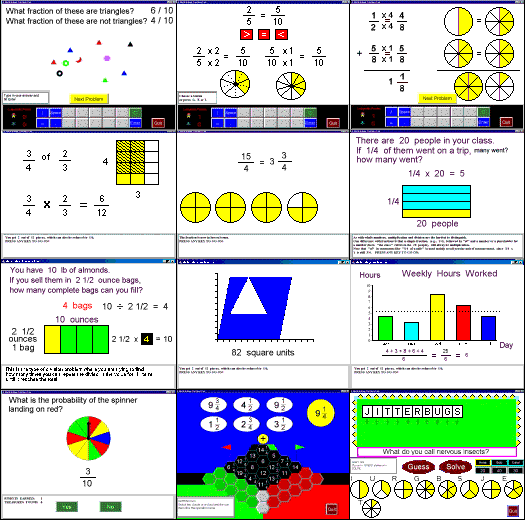
Math Galaxy Whole Numbers Fun - (grades 1-4) With 16 topics total, covers all of whole number operations, including time, money, length, area, volume, pictographs, bar graphs and probability.

Math Galaxy Fractions Fun - (grade 5) Over 14 topics covering equivalent fractions, comparing fractions, reducing fractions, improper fractions, prime factors, greatest common factor, LCM, adding, subtracting, multiplying, dividing, word problems, plus geometry, graphs and probability.

Math Galaxy Decimals, Proportions, % Fun - (grade 6) Covers decimals, ratios and proportions, and percents concepts and operations, plus geometry, graphs, data analysis and probability with 30 topics total.

Math Galaxy Word Problems Fun - (elementary and middle school) Sixteen topics cover whole numbers, fractions, decimals, multi-step problems, ratios & proportions, percents, negative numbers, time, length, area, volume, weight, angles and graphs & tables.

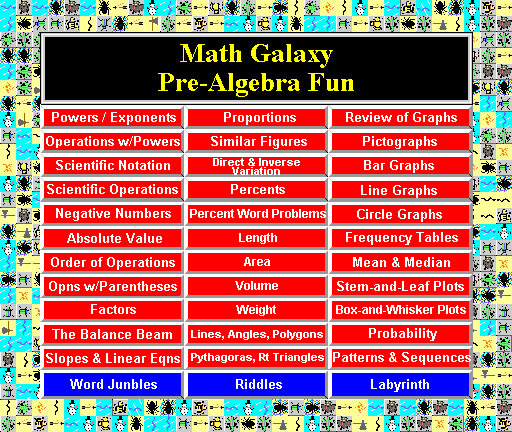
Math Galaxy Pre-Algebra Fun - (middle school) Covers 33 pre-algebra topics and concepts, including order of operations, scientific notations, exponents, factors and more.

Algebra Fundamentals - (middle school - high school) Thirty algebra topics including: negative numbers, 2-step equations, distance problems, coordinates & slopes, and more.

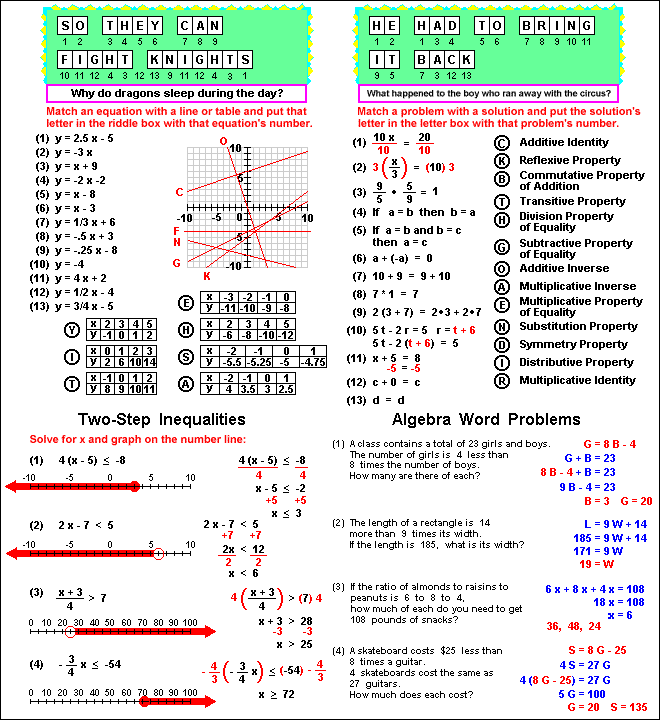
In addition to problems with step-by-step answers, each of the above has games to solidify the concepts. Whole Numbers Fun, Fractions, Fun, and Decimals have four games: Word Jumbles, Riddles, Bridge the Swamp and Labyrinth. Pre-Algebra has the same games, minus Bridge the Swamp and Algebra has Labyrinth only.

With the exception of one, the game-based Word Problems Fun, the software programs are a tutorial style, with detailed explanations for each problem. Users have a selection of problem types under the topic. Below you will find the home screen of the Pre-Algebra program.


The Math Riddler, the worksheet generator program, is available for the following topics: whole numbers, fractions, decimals, and algebra. This program topic includes all of the riddle and worksheet topics from the software, an unlimited number of problems, and 500 riddles. Each worksheet generator program costs $29.95 and is supplied on a CD.


E-books are available for whole numbers and fractions. The e-books come in PDF format and each include 130 of the 500 printable riddles and worksheets in the generator software. Each e-book is available for download for $14.95.

When I first started exploring the various topics, I have to admit I started to misjudge the program based on the outdated graphics.

The graphics had a bit of an 80s feel to them. They certainly were not sophisticated at all. Furthermore, there is no sound. But, just as you shouldn't judge a book by its cover, nor should you judge a software program by its graphics. At least, you shouldn't when the main objective is to teach math rather than simply entertain.

After getting over my flashback, I discovered that the instruction is quite sound and thorough. I really liked the step-by-step answers provided. For students that are solid on the steps already, they can forgo the explanations and select to proceed in "answer only" mode.

For example, the Negative Numbers selection on Algebra Fun has a review that consists of 18 screens of explanations and graphics. I found this quite in-depth for a basic algebra topic. Now, all of the topics didn't have a review and not all have as many screens. However, all the explanations all seem to be clear and sound. Once the student has reviewed negative numbers, they can continue on to answer three problem types -temperatures, word problems, and negative numbers - in either step-by-step or answer-only mode.

Another feature I liked was the motivation to earn robots in order to play the Labyrinth maze, which happened to be my son's favorite game. Students can earn a robot for either each problem they complete in the step-by-step mode or each problem they answer correctly in the answer-only mode. Once they run out of robots, they are locked out of the game until they earn more robots.

My daughter worked with the algebra software and my son the fractions. When I asked them what they liked the most, the both appreciated that you could earn robots to play the labyrinth game. My daughter mostly used the software as an extra practice tool for familiar topics and didn't rely on the step-by-step feature much. To get into the labyrinth quicker, my son did the same. However, I like that each topic is easily categorized and could easily be assigned, with full explanations, for weak areas. I don't always have time to get a step-by-step tutorial and this will be great for independent work while I'm occupied with another child.

Aside from the graphics being a stumbling block for me, the fact that there is no sound has its pros and cons. For us, I liked that there was no sound because playing the game didn't disturb any children in the room that were trying to do other school work. Sound is simply not needed to use the software. However, reading is. My kids are 10 and 13. I wondered how this might impact the programs covering earlier concepts being used by children that aren't strong readers.

Also, because we already have a lot of math software and products on our shelves, I personally might consider this product too costly given each program only covers one topic. However, each is covered quite thoroughly and can be used with multiple children. The value is hard to determine because it is based simply on how much the product will be used and how much your children will learn using it.

See for yourself! If you would like to get an idea on how this product would work for your students, you can try out partial editions of the tutorials, games, riddles and worksheets at the Math Galaxy website. The software also comes with a 30-day money-back guarantee.

Visit the TOS Homeschool Crew's blog to read more reviews on this product and others.

Disclaimer: This review was provided as a result in my participation in The Old Schoolhouse Magazine Crew. I was provided the product free of charge in exchange for my honest review. I strive to give a balanced overview of each product, detailing my opinion of both pros and cons and how the product worked for my family. What works for one family may not work for another. I encourage you to read reviews of other Crew members and research sufficiently to determine if any product will be a benefit to your homeschool.

Monday, February 22, 2010

Review: Math Mammoth


One thing that I really love about homeschooling is the opportunity to teach to mastery. It is a benefit that both of my kids need but neither would likely get in a typical classroom. In some areas, this allows them to move forward quicker and in others, it allows them to linger until the concepts sink in.

One area that we tend to linger is math. If the concepts are not mastered before moving forward, trouble will be down the road. One of my children raced ahead in math in the earlier years, but hit a wall once we headed into middle school territory. Some of this was developmental, but not truly mastering and understanding the steps learned previously was a contribution. For this reason, we've been spiraling in this subject for about three years, filling in holes, adding more practice problems, and drilling facts before moving on to the next level of material.

Math Mammoth is one tool we've used during lingering math stays. The author, Maria Miller, has a heart to help homeschooling moms give their children true understanding of the subject affordably. From the website:
My aim is to help parents and teachers teach math so our children and students can really understand what is going on. I've strived to explain the concepts so that both the teacher and the student can "get it" by reading the explanations in the books. In essence, the books become practically self-teaching.
I had the pleasure of reviewing Math Mammoth last year. Please do read the full review from last year as I used different workbooks during the review period and included additional information. However, for those new to Math Mammoth, the following is a repeat of the product lines available from Math Mammoth.

Math Mammoth has a full line of products for grades 1-12 to fill just about any need, whether it be a full curriculum, supplemental, or remedial resources. These downloadable workbooks are perfect when an area that needs more attention - right now - is discovered. There are several different series and collections available.

The Blue Series, Grades 1-5

Each worktext, containing both explanations and problems, in this series concentrates on only a few topics with varied problems for full understanding. The focus is on learning a particular topic; some of the books in this series cover several grade levels of material. This series is an excellent choice for remedial or supplemental work. Depending on the selected topic, cost for an ebook format is a very affordable $2-5.

The Lightblue Series, Grades 1-5

The Lightblue Series is a complete curriculum. The two worktexts (A & B) include answer keys, tests, cumulative reviews and an additional worksheet maker. Each grade level has limited topics, going deep rather than broad, and a longer time is spent on one topic for better learning. There is little prep work for the teacher. Children who can read will be able to self-teach with the clear explanations, including visual and puzzle exercises. The Blue and Lightblue series are essentially the same material, just organized and packaged differently. Each downloadable worktext is available for $15.50, or you can purchase both A & B worktexts for $29.70.

The Golden Series, Grades 3-8

This series is a collection of 120-150 worksheets for each grade for review and supplementation, starting with grade 3 and going through Algebra 1. The Golden series has problems only; concept explanations are not included. One topic per page is covered with variable problems for practice and understanding. Grade levels are available in two parts (A & B) with their corresponding answer keys available separately. Each part (A or B) is available for $6-9 and answer keys for $2. Complete packages are available for $12-14.

The Green Series, Grades 3-7

This series is similar to the Blue Series in structure and is organized by the topic. The worksheet collections may span several grades, making this series great for a comprehensive review and supplement of a particular topic. One topic per page is presented with variable problems, including word problems. The worksheets in this series are the same as those in the Golden Series, just arranged by topic rather than grade. Prices range from $2.50-9.

Make it Real Learning, Grades 3-12

This series has been added since my last review. Do you have a grumbling student because they don't see the purpose of math? This series, written by Frank Wilson, provides real life application of the math concepts your student is learning. The problem sets are meant for short usage, ideal for 1-2 class periods. If you have a high schooler or student that has covered material in the other series, look in this series for upper level material. Prices range from $4.99 individually or for $39.99 for the complete set.

Each series is also available in printed format, CD and in various packages and pricing structures. Purchase of certain packages also includes bonus Soft-Pac software.

If you are unsure of what grade level you need, Maria Miller is willing to consult parents on what might be a good option for your child. There are also placement tests available for the Lightblue series.

This time around I selected Algebra 1 Worksheets from the Golden Series and Linear Functions I from the Make It Real Series.

Algebra 1A Worksheets

The biggest thing to note with this particular series is that there are no explanations on how to do the problems. For us, that worked out perfectly because I am using this workbook as supplemental work to make sure the material is solidified. My daughter has no trouble following directions and solving a problem with examples for reference. However, after she has learned the new material, I want her to be able to understand the material well enough to apply it without explanation. Because one topic is covered per page with a variety of problems, this workbook has been a handy tool for practicing and checking understanding of new concepts.

Linear Functions I

This workbook is perfect for showing your Algebra student real-life examples of how they would use the math they are learning today. There are 10 scenarios with 6 questions to solve. Completely worked out solutions are provide. The first problem set my daughter worked out was titled "Choosing a Cell Phone Plan - T-Mobile". The series uses real situations and real companies to draw in more interest from the student. The cell phone plan application immediately caught my daughter's attention. It certainly didn't look like her typical worksheet. The workbooks in this series are not long (this one is 46 pages, solutions included), but may be just what your student needs for a change of pace and to see what they are learning really is useful!

Overall, Math Mammoth is an affordable and convenient math product. While I used our selections as supplements, please read some of the other Crew reviews to see how the complete curriculum option (the Light Blue Series) worked for other families.

Visit the Math Mammoth website for more information and to browse all the available workbooks and series. Make sure to take advantage of the offer for a free package of 280 worksheets and sample pages, an excellent way to try before you buy.

Disclaimer: This review was provided as a result in my participation in The Old Schoolhouse Magazine Crew. I received the above product at no cost in exchange for my honest review. I strive to give a balanced overview of each product, detailing my opinion of both pros and cons and how the product worked for my family. What works for one family may not work for another. I encourage you to read reviews of other Crew members and research sufficiently to determine if any product will be a benefit to your homeschool.

Sunday, February 14, 2010

Review: Ray's Arithmetic

Several years ago, an email circulated that contained the 8th grade final exam used in Saline County, Kansas in 1895. You can find a copy here. The point was to show that the education a child received over a hundred years ago was very different than the standard education of today. While some areas of our education system have made great advances, I'm not convinced that is the case across the board.

If you have interest in how subjects were taught in the frontier years and emulating that in your homeschool, you may consider exploring Dollar Homeschool. Dollar Homeschool has compiled a full curriculum, Eclectic Education Series (EES), of the very texts and materials used in America from roughly 1865-1915. Portions of the EES series are also available individually, Ray's Arithmetic being one of them. For review, I received the full Ray's Arithmetic series in a PDF format.

Ray's Arithmetic includes 38 titles, which includes 12 core textbooks, answer keys, and teacher guides covering K-12. Also included are extracurricular and interesting math related topics, such as Survey and Navigation and Astronomy. For a full list, click here.

The approach of Ray's Arithmetic is that students first learn concepts verbally. Is not until students fully understand the concepts that they express in written form. As to be expected with this approach, there are many word problems. Students who don't understand the concepts and instead are following steps will have much difficulty solving word problems; their heavy inclusion in this program certainly is a bonus. Ray's makes sure that students know the practical application of the math they are learning.

Emphasis is placed on spending as long as needed until concepts are fully mastered. With this curriculum, a stone at a time is laid in the foundation, slowly building on each. In addition, the curriculum, used during a time when schools weren't readily available and parents didn't have spare hours to teach, is designed for students to be independent in their learning.

When I first received this product, I was a bit overwhelmed. I would recommend starting with the Method of Manuals and A Manual of Arithmetic, which will give you an overview of the curriculum and approach. The quality of the scanned pages was not an issue, with the exception of an occasional illustration. Since the scans are formatted as images, you can't jump to sections within a text from an index. Scrolling through the document is necessary, which didn't help my aversion of digital products of this magnitude. However, the titles are indexed nicely according to level of difficulty, making finding a particular text simple.

Click here for more sample pages.

The Ray's CD is designed to be a printing curriculum. The titles range in size from 100 - 400 pages and you certainly wouldn't want to print all the titles at once! Print what you need or have your child read the text from the computer.

If I were just starting out homeschooling with young children, I can see using Ray's in the early years, especially if I were on a budget. The method seems to be a solid approach resulting in full understanding of the subject rather than memorization of steps or facts. Jumping in to this program would be more difficult with an older child, though there are suggestions for proper placement in the Welcome file of the CD.

While these titles are available on public domain, finding and downloading them all may be a bit of a time investment. Dollar Homeschool provides a service by doing the work for you. The other value added feature is that they have removed the answers next to the problems commonly found in other copies for the student texts. This way your student can work directly from the text and not have the answers provided. The books with answers in them are also provided, but are referred to as the "Teacher Editions".

Ray's Arithmetic on CD costs $59. Visit Dollar Homeschool to learn more about Ray's Arithmetic and other products available. All Dollar Homeschool products come with a 30-day unconditional guarantee and a full refund if you are not 100% satisfied.

Visit the TOS Homeschool Crew's blog to read more reviews on this product and others.

Disclaimer: This review was provided as a result in my participation in The Old Schoolhouse Magazine Crew in exchange for my honest review. I strive to give a balanced overview of each product, detailing my opinion of both pros and cons and how the product worked for my family. What works for one family may not work for another. I encourage you to read reviews of other Crew members and research sufficiently to determine if any product will be a benefit to your homeschool.

Sunday, January 31, 2010

Review: MathScore


One area that I try to have a lot of tools on hand is math. Books, software, games, topic workbooks, online tools - these are all items I keep on hand for when one of my children either needs a little more practice or explanation on a certain math topic.

This year with the TOS Crew has provided many math products to review and add to my toolbox, the latest being MathScore by Accurate Learning. Mathscore is an online subscription developed by MIT graduates and founded by Steven Yang. It is a no-nonsense program that is geared toward material a levels 2nd grade through Algebra 1. Using a mastery approach, Mathscore is proven to raise math test scores.

Students can start off with an assessment to identify a student's strengths and weaknesses. It is recommended that the assessments be used only with kids 4th grade and up. Once the assessment is complete, the program will suggest topics for the student. The goal is to work toward a 100 in a topic and more on the the next. Incentives and ranking are built in to the program to encourage students to work toward moving to the next level.

Each topic has various levels of difficulty with associated rating and points. A very nice feature is that MathScore has adaptable difficulty based on the performance of the student. Once mastery at a level is shown, the student moves on to the next. A time limit to complete online worksheets is given for each level. Students can work on any topic they like and are not locked out of certain topics as with other programs, though it is highly suggested that students first build up speed with typing (answer entry) and basic skills. For each topic and level, a mini-lesson, sample problems, and timed worksheets are available. The number of topics varies (20-92) for each grade level.

The get a better idea how the program works, you can view an introduction video and demo at the website.

What I really appreciate about this program is the tracking and information it provides to parents. A fairly detailed report is emailed to parents, including information such as: topics worked, rating, points, accuracy, %, # of worksheets completed, worksheet time and engaged time. My favorite bit of information provided, given I have one child that distracts fairly easily, is the a measurement of long gaps of idle time. After I let my son know that this information was provided to me, I got that deer-in-headlights look that told me he was going to do his best to stay on task. The parent account of the website gives access to other information regarding the student's time spent using the program, as well as access to all levels of worksheets.

I didn't find the program as flashy as others we've experienced, though that is not necessarily a bad thing. The ability to move up levels, earn points, and unlock 14 trophies is the primary motivation for students. There aren't games or many bells and whistles. This made the program less appealing to my kids, but it doesn't mean the program isn't effective. In other words, they weren't begging to work on MathScore, but when it showed up on their assignment sheet they put their work in with little trouble. My son did have some issue that the worksheets are timed, especially as he moved up in difficulty, but slow work is an area that I'd like to see improvement with both of my kids.

There are several pricing options for a MathScore subscription. The regular monthly rates are as follows:

First student: $14.95
Second student: $5.00
Each Additional student: $3.95

Upon first subscribing, the first two months for the first student is at a reduced rate of $9.95. There are also additional discounts if you opt to pay for a 9-month subscription or pay a lump-some amount. For example, a lump sum payment of $50 actually gives you $60 worth of subscription time on your account (a 20% bonus credit).

MathScore is a program to use for steady practice that documents clear progress. The website states that the average student using MathScore practices more than 10,000 problems a year using the program only one hour a week. That's a significant amount of practice! You can also read several articles of how using MathScore translated to a jump in scores in various test groups at the website. Mathscore's strength is the mastery approach to learning as well as the tracking and activity information provided to the parent. Its potential weakness is that is isn't as entertaining to the student. If a student regularly works with the program, the steady and easily measurable progress may be motivating enough, removing the need for a flashy program. If you are looking for a resource that allows your student to work independently with math learning and practice, you may want to look into MathScore further.

There is a free 2-week trial of MathScore available for you to try before you buy. The program is easy to get started and use and you should be able to give it a good enough workout during the trial period to determine if it will be a fit for your student. For more information, demos and articles on MathScore, visit the MathScore website.

Visit the TOS Homeschool Crew's blog to read more reviews on this product and others.

Disclaimer: This review was provided as a result in my participation in The Old Schoolhouse Magazine Crew, a team of 100+ homeschooling parents. While the product was provided at no expense to me in order to provide this review, I have not received any other compensation. Furthermore, receipt of the product does not guarantee a positive review. I strive to give a balanced overview of each product, detailing my opinion of both pros and cons and how the product worked for my family. What works for one family may not work for another. I encourage you to read reviews of other Crew members and research sufficiently to determine if any product will be a benefit to your homeschool.