My daughter has been taking an art class with our local support group. Each class starts with a bit of history on an artist and then the students complete a project in similar fashion. She's enjoying the class, both for the content and the company of her friends.
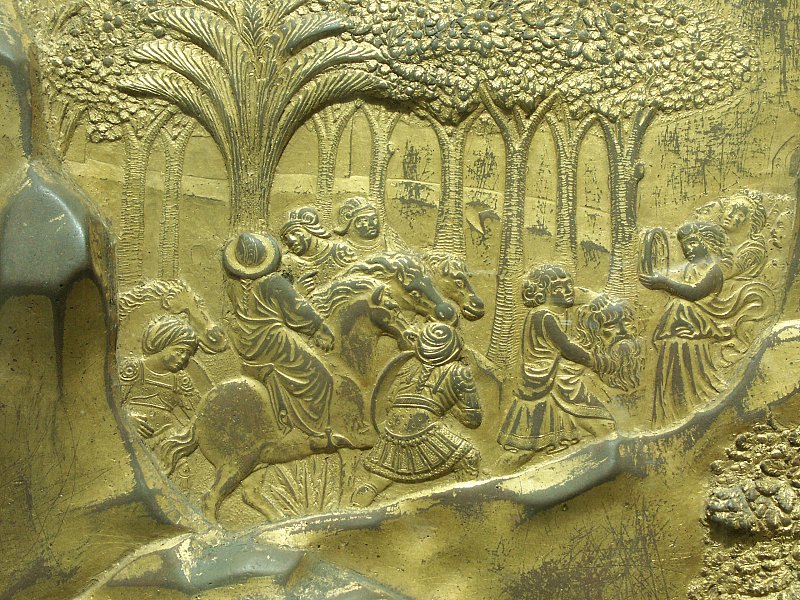
This week the class learned of the first great sculptor of the Renaissance, Lorenzo Ghilgerti. Ghilberti won a competition to design a set of doors for the Baptistry of the Cathedral in Florence in 1404. He spent the rest of his career working on these and another set, called (initially by Michelangelo) "The Gates of Paradise".
I think the project this week, experimenting with bas relief sculpture in clay, was dd's favorite so far. Unfortunately, I didn't get a picture yesterday before the piece started to dry and crack.
Note that this tree has leaves...a reminder that the trees aren't always bare in the freezing cold Michigan winters (February in Michigan is always the hardest!).
Her teacher shared a website where you can see pictures of copies and the originals (in the Duomo museum) of the work. You can see for yourself here. Below is just one of the many pictures of the original. I picked another one with leaved trees. Come on, spring!
It is well-known that part of prepping for the SAT exam involves vocabulary study, as evidenced by the numerous vocabulary programs geared toward high schoolers prepping for this important exam.
One of the options is VocabAhead, available in DVD-Rom or book form. I was sent the DVD version, which contains over 12 hours of audio narrations covering 1180 words in a variety of formats, to review. Both MP4 video and MP3 audio files are included for each word to be played on a computer, a MP3 player, or an iPod.
The video segments start with the word and definition, with the part of speech in the upper right-hand corner. Next, a cartoon is shown with the narrator giving a related story or stories, then a repeat of the word and definition. Each video segment is about 30-40 seconds long.
The audio files are simply the same as the video, without the cartoon. This format allows the user to use the product with a MP3 player and headphones, or while driving.
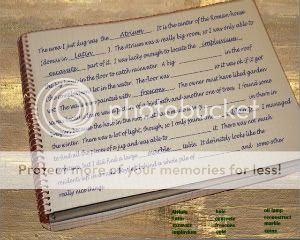
Below are some examples from the DVD:
I liked the format of hearing the definition, viewing a visual, and listening to a story. Having the definition wrapped up in a longer story, rather than simply hearing a definition, looking it up, or being given an example of the word used in a sentence, is a great tool for improving retention. However, I didn't always care for the story that went along with the definition. Some showed political bias, others had a focus on poor parenting. One definition used the story of a father questioning his child's paternity and another involved a pole dancer influencing "virtuous" men. Were the definitions explained clearly? Well, yes, but were such story lines really necessary? There was an obvious attempt to appeal to teenagers that resulted in a product that was of lower quality than it needed to be.
That said, I like the approach and the questionable definitions are limited to about 2%, as determined by viewing a random sample of the videos. The product really could be greatly improved with some rewriting of the 2% in question and a little thought behind the stories that go with the definitions. My daughter has a very high discernment and typically sees through any hidden agendas, so I was less concerned about her being influenced. Overall, she said it was "ok", which means she learned some new vocabulary, and neither the good nor the bad was overwhelming.
Does this product improve a student's vocabulary? Yes, I believe that it gives the student an understanding of the words presented in a way that is unique to other programs. However, I would not recommend this product for kids younger than high school, unless you are willing to preview videos. It could be an effective tool for older kids, but parents should be aware that definitions may not always be appropriate. I equate it to a movie that has a great story line and message, but contains enough sexual innuendos and foul language thrown in, that it starts to outweigh what makes it a good movie. The advantages of wading through the negative to be exposed to the positive greatly becomes a reflection of individual tolerance.
Fortunately, you can view about 90% of the videos on the DVD for free at the VocabAhead website along with have access to many other resources, such as the Study Room , a Word of the Day email subscription, a word list, and more, to make a personal assessment. The advantage of purchasing the DVD, which retails for $24.95 on Amazon, is that an internet connection isn't necessary for viewing and the files can be downloaded on an iPod or MP3 for on-the-go listening. Also available for purchase are a book with 300 of the words (and a link to download the corresponding videos) and applications for the iPod and iTouch.
Disclaimer: This review was provided as a result in my participation in The Old Schoolhouse Magazine Crew. I was provided the product free of charge in exchange for my honest review. I have received no other compensation.
I strive to give a balanced overview of each product, detailing my opinion of both pros and cons and how the product worked for my family. What works for one family may not work for another. I encourage you to read reviews of other Crew members and research sufficiently to determine if any product will be a benefit to your homeschool.
When my son was younger, he used to love those kit with a block of dried earthtone clay that contained buried treasure inside. He would chip away with the little tools included in the kit and be in pure archaeological heaven. Oh the mess those things made, though! If we weren't careful, there dust and dirt ended up everywhere. And while those kits were a ton of fun, I'm not sure he learned a whole lot other than Mom gets a little bent if he dumps a tray of clay particles on the floor.
Do you have a budding archaeologist? Combine that love with technology for a fun (and clean) learning experience about archaeology and Roman life with Roman Town.
Roman Town by Dig-It! Games and founded by a professional archaeologist and teacher, is an archaeological simulation game that combines the thrill of "treasure hunting" with real information about ancient Roman life.
Features include:
• Engaging hands-on, interactive learning
• Game-play develops analytical thinking
• Puzzles teach problem solving strategies
• Authentic artifacts and realistic excavation site
• Accurate information about Roman Life
and Roman History
• Encompasses the full excavation experience
from start to finish
• Archaeology introduced logically
The system requirements are:
• Windows Vista/XP/2000
• CPU 800 Mhz; RAM 412MB; Hard Drive 350MB
Seeing the game in action is probably better than any description I can provide. Please view the video below to get an idea of how all the features of the game work.
My son quickly became addicted to this game. Knowing it has educational value, he didn't hesitate to suggest that he play the game for school, often instead of something dreaded - like writing! The interactive nature and ability to discover artifacts was appealing and I liked that he was learning quite a bit about Roman culture. The game isn't limited to just learning about a culture, though, and approaches the topic through "hands-on" activities, analysis, problem solving, reading comprehension and vocabulary.
My son liked the "digging" for artifacts the best, along with the puzzles. He also said that he learned quite a bit about Roman culture through the activities. One thing I liked was the knowledge tests or journals, which required the user to fill in the blank with the appropriate word. My son said they made him think.
Users work through various levels and come to a point where the game is "completed". However, new artifacts to be uncovered each time the game is played again keeps repeat plays from being too repetitious. In addition, up to five different players can play and save their games. Even so, I'm not sure this is a game that my son would play over and over once all the levels are completed. I do see him being excited about a continuation of Roman Town. Coincidentally, Dig-It! Games is currently in the early stages of developing additional Volumes 2 and 3.
Dig-It! suggests the game for ages 8-88. While my 6th grader enjoyed the game, my 8th grader really wasn't interested when she saw her brother play. I'm not sure if that is a reflection of the level of the game, her indifference to most computer games, or the fact that she already knows more Roman culture than most her age. Regardless, I think mid-elementary to early middle school students with an interest in archeology will find Roman Town engaging. If you don't have a strong reader, keep in mind that the user needs to read the material on the screen; it does not read it to you.
Overall, I thought Roman Town was a great combination of fun and learning. My son had a ton of enthusiasm for the game and diligently worked through the various levels. I think Roman Town would be a perfect compliment to early Latin study or to supplement related history topics.
Winner of the National Parenting Center's 2010 Seal of Approval and Dr. Toy's Best Vacation Products, Roman Town is regularly priced at $39.95 for a CD version. However, using coupon code TOS2011, Roman Town is just $19.96 - a significant savings! The coupon code is only valid through February 21, 2011, so act now if you'd like to get in on the special pricing for TOS Crew readers. You will not find this offer advertised on the Dig-It! Games website.
Disclaimer: This review was provided as a result in my participation in The Old Schoolhouse Magazine Crew. I was provided the product free of charge in exchange for my honest review. I have received no other compensation.
I strive to give a balanced overview of each product, detailing my opinion of both pros and cons and how the product worked for my family. What works for one family may not work for another. I encourage you to read reviews of other Crew members and research sufficiently to determine if any product will be a benefit to your homeschool.
My daughter's American History class has several projects throughout the year. Usually she is given flexibility in how to complete the projects. This past semester she had two large projects, both of which she decided to present with technology. Her work on both of these projects was very focused and she completed them both well before the due date. That is saying a lot for Miss Procrastinator. Obviously she enjoyed creating them, and I enjoyed seeing the end result. I just wanted to share them as examples of how technology can be used for learning.
The first was a research project on any history topic approved by the teacher. Using a video presentation, she chose to explore the things about Christopher Columbus that the history books usually don't tell you. As you'll notice from the graphics used, it is hard for my daughter to not incorporate her quirky sense of humor into her work. (Warning: There is mention of a mature topic related to the treatment of women. Please make sure younger children are not around when viewing, or preview first.)
The same class required a timeline over the period covered for the semester. I have to say, she wasn't thrilled with making a timeline (it must be genetic...). She dragged her feet on this one, until she discovered a way for it to be created digitally at www.dipity.com. This site is free, and a very cool way to do a timeline. You can view my daugther's timeline here. What is also neat is that you can use another host for the timeline for your very own timeline web page. She used www.webs.com to do this. Don't ask me how that is accomplished, because I have no clue, sadly! It is the exact same timeline, but at a personal website. You can view it here. (Note: some computers seem to have a block on this site until it has been up for 7 days.)
I hope that gives some ideas for how you can use technology for homeschool projects and learning. It's educational, green, motivating...and in our house...painless!
When I discovered that the fairytale audio CDs by 6 Pence Productions are voiced entirely by children 5-17, I was immediately interested. If you've been a reader in the past, you've probably figured out that both of my kids enjoy theater. Combine that with a love of audiobooks and an appreciation of an imaginative story, and the "stage" is set to enjoy a CD by Audio Theatre for Kids - By Kids!
The Fairytale Collection, which has a total running time of almost an hour, retells five classic fairytales. However, the retellings aren't exactly the versions you remember. Three Billy Goats Gruff, Cinderella and Friends, The Emperor's New Clothes, The Three Little Pigs Meet the Big Bad Wolves, and Princess and the Pea are presented with modern flair and unexpected twists. The suggested age range for this CD is 3-8. It will be enjoyed more if listeners have previous knowledge of the original versions, but they are enjoyable enough as is.
The second CD, the Princess Reform School, is suggested for ages 6-13. Rather than separate stories, the CD is one 1 1/2 hour story, based on the a play originally performed at Flat Rock Playhouse, The State Theatre of North Carolina.
The story is about some rather unconventional princesses attending a reform school to make them better at being "princessly". The underlying story revolves around the self-acceptance of girls while navigating societal expectations and pressures.
My kids were on the older side for these CDs. My daughter, who does a fair amount of snubbing societal expectations for girls, would have loved Princess Reform School around the age 8 or 9. Even so, she still claimed the Princess Reform School was "cute" and proceeded to tell me the names of several younger girls that she thought would love it. It also isn't so girly that boys can't enjoy it, though it wouldn't be my first choice for boys. My son dubbed it a "chick flick", but I also noticed that he chose to listen to it over lunch rather than stick his nose in a Star Wars book. I plan to give The Fairytale Collection to my 5-year-old niece to enjoy. She's the perfect age for this CD.
What I liked the most about both CDs was simply the performance of the kids. They were exceptional and the CDs were very professionally done. And I have a sense that the whole cast tremendously enjoyed producing the CDs. With one child who is about all things theater and performing, it was fun to listen to these imaginative stories done entirely by kids.
There are sample tracks available on the 6 Pence Players website, where you can also make a purchase of both titles.
Disclaimer: I received both CDs free of charge in exchange for my honest review.